
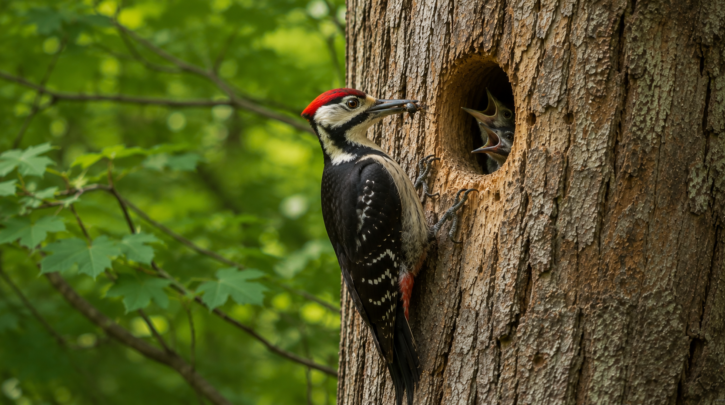

Summer covers the full arc of a typical woodpecker nesting attempt — incubation, an unusually long nestling period for a bird this size, fledging, and the beginning of a slow, practice-heavy transition to independence.
This site participates in affiliate programs. If you buy through a link on this page, we may earn a commission at no extra cost to you. Affiliate disclosure
Incubation and Hatching
Both parents share incubation, with the male typically taking the overnight shift as covered in our eggs guide. Incubation runs roughly 11 to 18 days depending on species, with smaller species hatching faster than larger ones.
A Long Nestling Period
Woodpecker chicks stay in the cavity considerably longer than similarly sized songbirds — 20 to 28 days depending on species, compared to a bluebird’s 17 to 21 days or an oriole’s fast 12 to 14 days. See our baby woodpeckers guide for the full species-by-species breakdown and why the enclosed cavity allows this slower pace.
Feeding a Growing Brood
Both parents feed chicks throughout the nestling period, delivering wood-boring insects and other prey covered in our diet guide. Loud begging calls audible from outside the cavity are often the clearest sign of an actively growing brood.
Fledging
Thanks to the protection the cavity provides throughout development, fledglings tend to leave already reasonably capable fliers, clinging to nearby bark and testing short flights rather than the more tentative ground-bound stage seen in many open-nesting species.
Learning to Excavate
Independence doesn’t mean competence. Young woodpeckers spend weeks after fledging watching and imitating parental foraging technique, since excavation is a genuinely learned skill that improves with practice rather than something a young bird performs efficiently from day one.
Post-Breeding Molt Begins
By late summer, adults begin a post-breeding molt, replacing feathers worn from the demanding nesting season. Because most of these species don’t migrate, there’s no pressure to complete this molt on a tight schedule the way an oriole preparing for migration would need to.
Curious how a resident species’ year differs from a migratory one? See our migration guide for the full comparison.
A Single Brood, Generally
Most woodpecker pairs raise one brood per season, similar to orioles and unlike the two or three broods a bluebird pair might attempt. A failed early attempt may prompt a second try in a new cavity, but a successful first brood typically completes the breeding season for that pair.
Family Groups After Fledging
Once young fledge, it’s common to see them remaining near the nest tree for several weeks, still accompanied and fed by both parents while flight and foraging skills continue developing. This extended family association gives young birds an unusually long apprenticeship compared to species that push independence faster.
Water Needs in Summer Heat
Hot summer weather makes a reliable water source more valuable than usual, both for adults and for parents making frequent feeding trips in the heat. A shallow birdbath, kept clean and topped off, benefits woodpeckers alongside nearly every other backyard bird during the hottest stretches of the season.
Watching Excavation Practice in Young Birds
Fledged young attempting their own tentative excavation on soft or already-decayed wood, often with visibly less efficiency than an adult working the same material, is a genuinely interesting thing to observe if the opportunity arises — a clear, visible demonstration of skill development that most bird behaviors don’t make nearly as easy to witness firsthand.
Summer Feeder Activity
Suet feeder visits often dip somewhat during the height of summer as natural insect availability peaks alongside the breeding season, then pick back up gradually as summer progresses and both adults and increasingly independent young return to supplemental feeding more regularly.
Comparing Summer to Other Species
A woodpecker’s summer, with its long nestling period stretched out over most of the season, contrasts sharply with an oriole’s compressed few weeks from hatching to independence. Both patterns reflect the same underlying tradeoff in different directions — an enclosed, well-protected cavity allows a slower, safer developmental pace, while an exposed pouch nest favors speed over safety.
If you want to catch parents bringing fledglings to the feeder, a camera feeder like the Birdfy Feeder Metal 2 4K records every visit automatically.
Heat and Cavity Ventilation
A well-excavated cavity generally handles summer heat reasonably well thanks to the insulating properties of solid surrounding wood, though a cavity in a very exposed location with little surrounding shade can still run warmer than an equivalent cavity in a shadier spot, an important factor parents likely weigh when selecting an excavation site in the first place.
A Season Defined by Patience
More than almost any other stage in the woodpecker year, summer rewards patience — the extended nestling period, the gradual post-fledging apprenticeship, and the slow molt that follows all move at a pace shaped by the safety the cavity provides, rather than the urgency that characterizes an open-nesting or migratory species’ summer.