
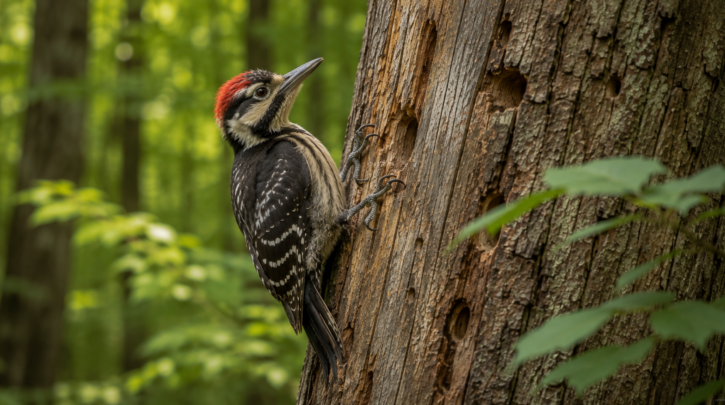

Woodpecker chicks develop inside one of the most protected nest environments in the backyard bird world — a fully enclosed wood cavity — and that protection comes with a noticeably longer nestling period than most similarly sized songbirds.
At Hatching
Newly hatched woodpeckers are altricial: blind, featherless, and completely dependent on their parents. Because both parents share incubation duties, including the male’s overnight shift covered in our eggs guide, chicks typically hatch within a day or so of each other.
A Longer Nestling Period Than Most Songbirds
- Downy Woodpecker: roughly 20 to 25 days from hatching to fledging
- Hairy Woodpecker: a similar or slightly longer period than Downy
- Red-bellied Woodpecker: roughly 24 to 27 days
- Northern Flicker: roughly 24 to 27 days
- Pileated Woodpecker: roughly 26 to 28 days, the longest of the five common backyard species
This runs noticeably longer than a bluebird’s 17-to-21-day nestling period, and considerably longer than an oriole’s fast 12-to-14-day window. The fully enclosed cavity removes much of the predation pressure that pushes an exposed-nest species like an oriole toward a faster developmental timeline, allowing woodpecker chicks to develop more slowly and fledge with a greater degree of physical readiness.
Feeding Inside the Cavity
Both parents feed chicks, initially by regurgitation and later with whole insects delivered directly, following the same wood-boring-insect-heavy diet covered in our diet guide. Feeding visit frequency increases considerably as chicks grow and their combined food demand rises.
Begging Calls as a Monitoring Tool
Because the cavity is fully enclosed, loud begging calls audible from outside are often the first and most reliable sign that a cavity is actively occupied by growing chicks, well before any chick is visible at the entrance. This makes sound, more than sight, the primary way to confirm nest activity for anyone monitoring from a distance.
Fledging
Given the protection the cavity provides throughout development, fledglings tend to leave the nest already reasonably capable fliers rather than the more tentative, ground-bound stage seen in many open-nesting species immediately after leaving the nest.
After Fledging: Learning to Excavate
Independence doesn’t mean immediate competence. Excavation is a learned skill that improves with practice, as covered in our nest cavity guide, and fledged young continue watching and imitating parental foraging technique for several weeks before becoming genuinely efficient at extracting insects from bark and wood on their own.
Post-Fledging Dependency
Parents typically continue feeding fledged young for several weeks after leaving the cavity, a gradual transition period during which young birds practice both flight and foraging technique under continued parental supervision before becoming fully self-sufficient.
Want to give a future brood the best chance? Revisit our attracting guide to make sure your property still offers suitable excavation sites for next season.
How Both Parents Divide Feeding Duties
Feeding duties are shared fairly evenly between the male and female through the nestling period, consistent with the more balanced parental investment pattern already seen in incubation. This even division continues into the post-fledging period as well, with both parents typically involved in supervising and feeding young after they’ve left the cavity, rather than one parent taking over disproportionately.
Recognizing a Fledging Event
Fledging from a woodpecker cavity often happens somewhat more gradually than the near-simultaneous departure seen in some open-nesting species, with individual chicks sometimes appearing at the entrance hole and testing short flights over a period of a day or more before fully leaving the nest tree.
What to Do If You Find a Recently Fledged Woodpecker
A young woodpecker found clinging low on a tree trunk or fence post shortly after fledging is usually not in distress — this is a normal transitional stage, and a parent is very likely nearby continuing to feed and supervise it. As with most fledgling birds, leaving it alone unless it’s in clear, immediate danger is almost always the right approach.
How This Compares to Other Species
A fledged woodpecker clinging to bark and testing short vertical hops is a genuinely different sight from a fledged bluebird hopping on open ground or a fledged oriole navigating leafy branches — each species’ fledgling behavior echoes the same physical adaptations that define the adults, with young woodpeckers already showing the climbing instinct their zygodactyl feet and stiff tail are built for, even before they’re fully proficient at putting either one to fully reliable, confident use out in the wild.
A Full-Circle Return to the Nesting Cycle
Once independent, young woodpeckers spend their first year building the foraging and excavation skills that will eventually let them establish their own territory and, in most cases, dig their first cavity of their own the following breeding season — closing the loop back to the excavation process covered in our nest cavity guide and starting the entire cycle over again for a new generation.