
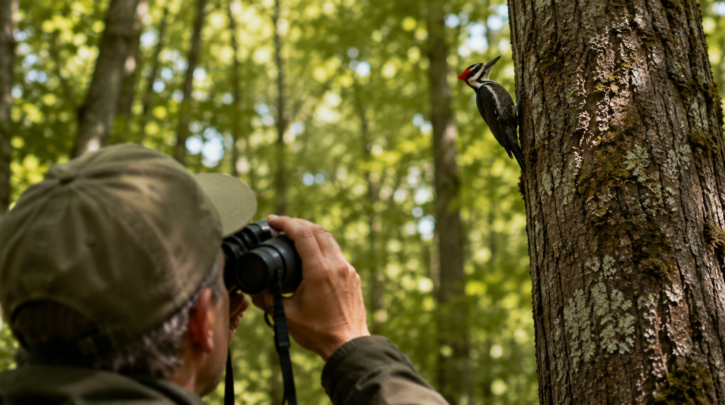

Standard birding binocular advice assumes a bird sitting in the open on a branch or perched at a feeder. Woodpeckers break that assumption constantly — they cling vertically to trunks, hold still against bark that’s practically camouflage-printed for them, and show up at awkward straight-up angles that no feeder-watching guide accounts for. The problems below are specific to that reality, along with the binocular feature that actually solves each one.
Problem: I can hear it drumming, but I can’t find it on the trunk
This is the single most common frustration in woodpecker watching, and it’s a field-of-view problem, not a magnification problem. A narrower field of view — common on higher-magnification binoculars — shows you a smaller slice of the tree at a time, so by the time you’ve panned to the sound, the bird has often shifted position or gone quiet. See our drumming and calls guide for how directional and often deceptively far-carrying drumming sound can be, which makes a wide initial search field even more valuable.
Solution: Stick with 8x, not 10x
An 8x magnification gives a noticeably wider field of view than 10x at the same objective lens size, letting you scan more of a trunk and its surrounding limbs in one sweep rather than hunting in narrow slices. This is the same reason 8x is the standard recommendation for general birding, but it matters more here specifically because the search area — an entire vertical trunk plus branches — is larger and less predictable than a feeder or open perch.
Problem: The bark pattern camouflages it completely, even once I’ve found the right tree
Downy and Hairy Woodpeckers in particular blend into mottled gray-brown bark almost as well as they stand out against clean feeder wood. A barred or spotted back pattern against a similarly textured trunk is exactly the kind of low-contrast scene that separates binoculars that merely magnify from binoculars that actually resolve fine detail.
Solution: Prioritize resolution and contrast over raw magnification
ED (extra-low dispersion) glass and fully multi-coated lenses are what actually let you pick a barred back pattern apart from bark texture at a glance, rather than squinting at a gray blur and guessing. This matters more for woodpeckers than for most backyard birds, since the field marks separating species — see our species identification guide — are often fine pattern and proportion differences rather than bold color blocks that would stand out regardless of lens quality.
| Feature | Why It Matters Against Bark |
|---|---|
| ED glass | Reduces color fringing that blurs fine barring and spotting patterns |
| Fully multi-coated lenses | Improves contrast and light transmission in dappled forest shade |
| Phase-corrected roof prisms | Sharper resolution at the fine detail level bark camouflage demands |
Problem: My binoculars shake too much when I’m looking straight up
Woodpeckers spend a lot of time well overhead — higher on the trunk than a feeder bird, often directly above rather than at eye level. Holding any binocular steady with your arms raised and your head tilted back is mechanically harder than a level, relaxed hold, and hand shake gets magnified right along with the image.
Solution: Lower magnification, plus a genuine bracing habit
This is a second, separate reason to favor 8x over 10x: shake is proportionally magnified along with the image, so the same hand tremor that’s barely noticeable at 8x becomes genuinely disruptive at 10x, especially overhead where your arms have no natural brace point the way they do holding binoculars at chest height. Beyond magnification, actively bracing your elbows against your chest or a nearby tree trunk, rather than holding your arms free in the air, cuts shake noticeably on any binocular during an extended straight-up viewing session.
For very long overhead sessions — watching an active nest cavity for an hour or more — a monopod or window-mount adapter takes the strain off your arms entirely, though it sacrifices the ability to quickly re-aim if the bird moves.
Problem: By the time I focus, it’s moved to the other side of the trunk
Woodpeckers routinely spiral around a trunk while foraging, ducking out of sight and reappearing a foot or two away, often closer than expected since a good feeding tree can be quite near a house or trail.
Solution: A fast focus wheel and a genuinely close minimum focus distance
A center focus wheel that only needs a short turn to go from close to distant focus lets you re-lock onto a bird that’s reappeared at a different distance without losing the moment. Close focus distance matters more here than in general backyard birding, since woodpeckers are frequently spotted at close range — on a suet feeder covered in our feeders guide, or a nearby trunk — and a binocular that can’t focus much closer than 15 or 20 feet leaves you unable to use it at exactly the range a lot of woodpecker sightings happen.
Problem: My binoculars fog up or feel unreliable in the damp, wooded conditions woodpeckers actually live in
Woodpecker habitat skews toward exactly the conditions that are hardest on optics: shaded, often humid forest and woodland edge, not the open, dry backyard a feeder-watching guide typically assumes. See our habitat and range guide for how consistently this species group favors wooded cover over open ground.
Solution: Nitrogen- or argon-purged, O-ring sealed construction
Waterproof and fogproof construction — binoculars purged of internal air and replaced with nitrogen or argon gas, then sealed with O-rings at every joint — prevents the internal fogging that plain “water-resistant” models are prone to when moving between temperature and humidity extremes, which happens constantly in wooded habitat between shaded understory and sunlit clearings. This is a genuine step up from splash resistance, not just marketing language, and it’s worth checking specifically rather than assuming any midrange binocular has it.
Problem: Even with a clear, steady view, I still can’t tell if it’s a Downy or a Hairy Woodpecker
This one isn’t really a binocular problem at all — it’s an identification problem that good optics only partially solve. Downy and Hairy Woodpeckers differ mainly in size and bill length, both of which require a genuinely sharp, high-contrast, close-focused view to judge with any confidence.
Solution: Combine the optical fixes above, then apply the actual field test
Once resolution, contrast, and close focus are handled by the binocular itself, the remaining step is knowing what to look for: relative bill length against head width is the most reliable separator between the two species. Our species identification guide walks through the comparison in detail — worth reviewing before you’re in the field, since it’s much easier to apply a comparison you already know than to work it out in real time with a bird that may not hold still long.
Problem: My arms get tired fast during a long stakeout at a nest cavity
Watching an active cavity through the incubation and feeding period covered in our eggs guide can mean genuinely extended viewing sessions, often at the overhead angles already covered above.
Solution: Weight, strap distribution, and knowing when to switch tools
A full-size 8×42 binocular typically weighs noticeably more than a compact model, and that difference adds up fast during an hour-plus session. A harness-style strap that distributes weight across both shoulders, rather than a single neck strap, meaningfully reduces fatigue on long sessions. For genuinely extended, hands-free monitoring of a single cavity over days or weeks rather than a single outing, our trail camera guide covers a setup that removes the arm-fatigue problem entirely by not requiring you to hold anything at all.
Quick Reference: Specs That Matter Most for Woodpecker Watching
| Spec | Recommendation | Why |
|---|---|---|
| Magnification | 8x | Wider field of view for locating a drumming bird; less shake overhead |
| Objective lens | 42mm | Enough light gathering for shaded, wooded habitat without excess weight |
| Close focus distance | Under 10 ft if possible | Woodpeckers are often spotted at close, feeder-level range |
| Glass/coating | ED glass, fully multi-coated | Resolves fine barring and bill detail against bark camouflage |
| Weatherproofing | Nitrogen/argon-purged, O-ring sealed | Wooded, humid habitat is harder on optics than open yards |
| Weight/strap | Full-size with harness strap | Reduces fatigue during extended overhead cavity-watching sessions |
Where to Buy
B&H Photo carries a wide range of birdwatching binoculars across price points, with detailed spec comparisons that make it easy to check close focus distance and weatherproof rating side by side before buying — the two specs most worth double-checking for woodpecker watching specifically.
Putting It to Use
A pair chosen against the problems above earns its keep the first time a distant drumming sound turns into a confirmed, correctly identified bird instead of a gray blur on a gray trunk. For more on turning that clear view into a confident species call, see the full identification guide, or the Cornell Lab’s general binocular testing guide for a broader look at evaluating optics beyond the woodpecker-specific factors covered here.