

Unlike bluebirds or orioles, whose ranges split fairly cleanly along east-west lines, most common backyard woodpecker species overlap broadly across nearly all of North America. Habitat quality — specifically the availability of dead and dying wood — matters more for these species than range alone.
Downy Woodpecker
The most widespread woodpecker in North America, found across nearly the entire United States and Canada outside of the far northern tundra and the driest desert Southwest. Downy Woodpeckers adapt readily to suburban yards, parks, and fragmented woodlots, making them the species most backyard hosts encounter first.
Hairy Woodpecker
Similarly widespread across the US and Canada, but with a stronger preference for more mature forest with larger trees than Downy Woodpeckers require. Hairy Woodpeckers are somewhat less tolerant of heavily fragmented or suburban habitat, though they still visit yards with substantial mature tree cover nearby.
Red-bellied Woodpecker
Historically concentrated in the southeastern and eastern United States, Red-bellied Woodpecker range has expanded noticeably northward and westward over recent decades, now well established into New England and the upper Midwest in areas where it was rare or absent a few generations ago. This ongoing range expansion is well documented and continues in many regions.
Northern Flicker
Among the most widely distributed woodpeckers in North America, found across nearly the entire continent. Unlike the other species on this list, Flickers need open ground as much as trees, since so much of their foraging happens on the ground digging for ants rather than on bark.
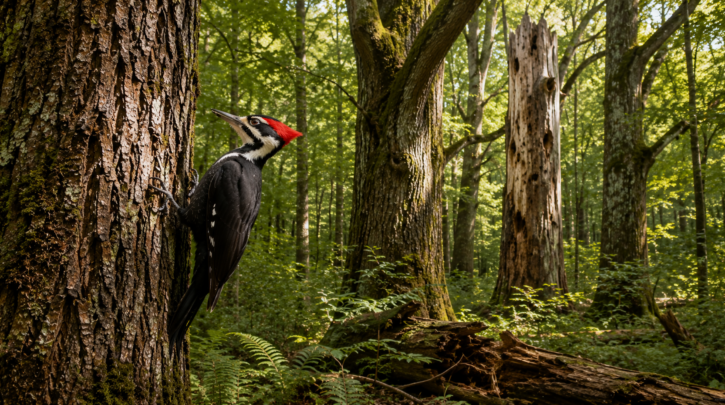
Pileated Woodpecker
Requires mature forest with substantial large trees capable of supporting its considerably larger excavated cavities. Pileated Woodpeckers retreated from many heavily logged areas historically but have recovered and expanded significantly as eastern forests have matured back over the past century.
Why Dead Wood Matters More Than Raw Forest Cover
As covered in our diet guide, dead and dying wood hosts dramatically more insect activity than healthy living wood, which is why the presence of standing dead trees, not simply the amount of forest cover, is often the better predictor of woodpecker activity on a given property. A younger, tidier woodlot with little dead wood can support fewer woodpeckers than an older, messier one with several standing snags.
Suburban and Urban Tolerance
Downy Woodpeckers in particular tolerate suburban development well, provided mature trees remain part of the landscape. Larger species, especially Pileated Woodpecker, generally require more substantial tree cover and are less likely to be regular visitors in heavily developed areas with only scattered young trees.
Curious whether local woodpeckers stick around all year or move seasonally? See our migration guide for the species-by-species pattern.
Elevation and Regional Habitat Notes
Most of these five species are habitat generalists at the elevation level, found from lowland riparian corridors up into montane forest across much of the western part of their ranges, with specific elevation limits varying more by local tree species composition than by any strict elevational preference of the woodpeckers themselves.
Range Expansion as an Ongoing Process
The Red-bellied Woodpecker’s documented range expansion isn’t a one-time historical event — it’s an ongoing process that continues to shift the species’ northern and western range boundary in real time, tracked through citizen-science reporting and regional birding surveys. Anyone in a region where Red-bellied Woodpeckers were historically rare or absent may find the species becoming a more regular presence over the coming years rather than remaining a fixed absence.
What Drives Range Expansion
Warming winter temperatures and increased backyard feeding, particularly suet availability, are generally cited as contributing factors in this kind of northward range expansion, since both reduce the winter survival barrier that historically limited how far north a species dependent on insect prey and cached nuts could reliably overwinter.
Comparing Habitat Needs Across the Five Species
Downy Woodpecker sits at one end of the habitat-flexibility spectrum, thriving in small suburban lots with just a few mature trees. Pileated Woodpecker sits at the other end, needing substantial tracts of mature forest to support its size and excavation demands. The other three species fall somewhere in between, generally tolerating more fragmentation than Pileated but less than Downy.
What This Means for a Typical Yard
A property with even a modest number of large, mature trees and some tolerance for standing dead wood can realistically expect regular visits from Downy, and often Hairy and Red-bellied Woodpeckers as well, without needing anything close to the substantial forest tract a Pileated Woodpecker requires. Setting expectations by species, rather than assuming every yard should attract all five, leads to a more realistic and satisfying hosting experience.