
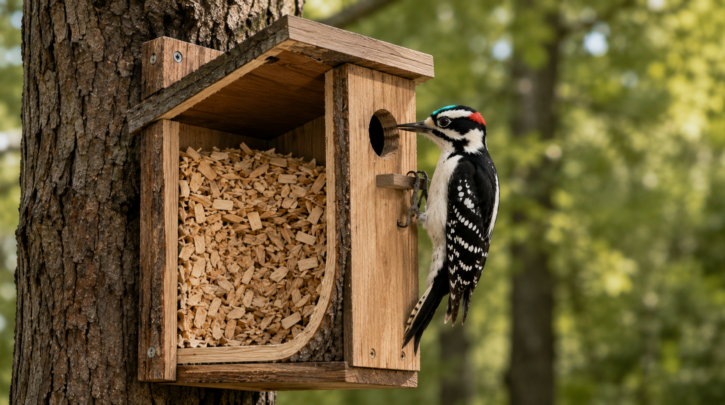

A standard, empty birdhouse doesn’t work for woodpeckers — the whole appeal of a cavity, for this family, is excavating it themselves. See our full nest cavity guide for why that matters before picking a box.
What Makes a Woodpecker Box Different
- Filled or fillable with wood chips, tamped down to a soft-solid consistency the bird can excavate rather than an empty chamber
- A correctly sized entrance hole for the target species — see our nest cavity guide for the size breakdown by species
- A predator guard around the entrance to prevent squirrels or other animals from enlarging the hole
- An openable panel for cleaning and, where relevant, refilling wood chips
Coveside Downy Woodpecker House
Built from sustainably grown Eastern white pine with a recycled slate guard around the entrance — sized correctly for Downy Woodpecker and shipped with wood shavings meant to be packed one to two inches deep inside the box. The slate guard does double duty, deterring squirrels while also preventing the entrance from being enlarged by other wildlife.
See: Coveside Downy Woodpecker House
Flicker Houses With Anti-Starling Design
Because Northern Flicker cavities are large enough for European Starlings to invade — covered in detail in our predator guide — some flicker-specific boxes use a design where the entrance is only approachable from below, exploiting a flicker’s tree-climbing ability in a way starlings, which don’t climb the same way, struggle to use. This kind of angled or shielded entrance is worth prioritizing specifically in areas with heavy starling pressure.
See: Flicker Houses With Anti-Starling Design
BestNest-Style Three-Woodpecker House
A mid-sized box designed to suit Red-headed, Hairy, and Red-bellied Woodpeckers with a single design, useful for a property that might attract any of several mid-sized species rather than targeting one specifically.
See: BestNest-Style Three-Woodpecker House
Filling the Box Correctly
Wood chips need to be packed firmly — tamped down to a soft-solid consistency rather than left loose — so the bird has something to genuinely excavate rather than an empty cavity that skips the behavior altogether. Most purpose-built woodpecker boxes ship with an appropriate quantity of chips included.
Placement
Mount securely to a tree trunk or sturdy post, never in a free-hanging configuration, since woodpeckers generally avoid boxes that move or swing. Species-specific height preferences vary considerably, with larger species like Pileated Woodpecker generally favoring greater height than Downy or Hairy.
Dealing with a woodpecker targeting your house instead of a box? See our deterrent guide for how to redirect that activity.
Refilling Wood Chips Over Time
A box that’s successfully used for one nesting season will have its wood-chip fill largely excavated and displaced by the time the brood fledges, so plan on refilling and re-tamping fresh chips before the next breeding season rather than assuming the original fill will still be usable. Most manufacturers or garden retailers sell replacement wood-chip bags separately for exactly this purpose.
Cleaning Between Seasons
Unlike a bluebird box, which just needs old nest material removed, a woodpecker box benefits from a full clean-out and repack with fresh chips each year, both for hygiene and because a compressed, previously-excavated fill doesn’t offer the same soft-solid excavation experience a fresh pack provides.
Sizing for Multiple Species
Because entrance hole size varies so directly by species, as covered in our nest cavity guide, it’s worth deciding which species you’re actually hoping to attract before buying rather than assuming one generic box size works for the whole family. A box sized for Downy Woodpecker simply won’t accommodate a Pileated, regardless of how appealing the wood-chip fill is.
A Reasonable Expectation
Even a well-built, correctly filled box may take more than one season to attract a woodpecker pair, particularly in an area with abundant natural dead wood already available as an alternative. Patience, combined with correct sizing and placement, gives a purpose-built box the best realistic chance of eventual use.
Where Box Placement Beats Retained Dead Wood
A nest box makes the most sense as a supplement in areas genuinely lacking natural dead wood — a newer suburban development, for instance, or a property that already lost its snags before understanding their value. Where suitable dead wood already exists on a property, retaining it typically outperforms even the best purpose-built box, since it offers foraging habitat alongside nesting potential in a way no purpose-built box can fully replicate on its own.
Setting Realistic Expectations for New Boxes
Even in ideal conditions, a newly installed woodpecker box competing against abundant natural dead wood nearby may simply go unused while the birds continue relying on existing habitat, which isn’t a failure of the box itself so much as a sign the surrounding habitat is already doing its job well. A box is most valuable precisely where that natural alternative is missing.