
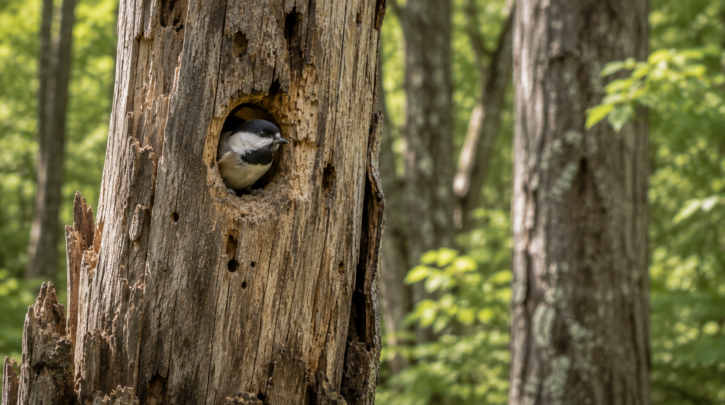

A woodpecker typically uses a freshly excavated cavity for only one or two nesting seasons before moving on and digging a new one elsewhere. What happens to that abandoned cavity is one of the more quietly important dynamics in the entire backyard bird world.
Secondary Cavity Nesters: A Whole Community
Dozens of North American bird species cannot excavate their own nesting cavity and depend entirely on either a natural cavity or an abandoned woodpecker hole. Chickadees, titmice, nuthatches, wrens, screech owls, American Kestrels, and Tree Swallows are all documented users of old woodpecker cavities, alongside non-bird residents like flying squirrels.
The Bluebird Connection
Before nest-box programs became widespread, old woodpecker cavities were one of the primary natural nesting sites available to bluebirds. See our nest cavity guide for how these cavities are originally created — a property with active woodpeckers is, indirectly, also supporting the local bluebird population.
Cavity Size Determines Which Species Can Use It
A small Downy Woodpecker cavity, with its roughly 1¼-inch entrance, suits chickadees and similarly small birds. A Northern Flicker’s considerably larger cavity can accommodate American Kestrels, which regularly use old Flicker holes as an alternative to nest boxes. Old Pileated Woodpecker cavities, the largest of the group, are big enough for wood ducks and medium-sized owls.
Why This Makes Woodpeckers an “Ecosystem Engineer” Species
Ecologists use the term ecosystem engineer for a species whose activity creates habitat that directly benefits many other species — and woodpeckers fit the definition about as clearly as any North American bird. The excavation behavior covered in our nest cavity guide isn’t just about woodpecker reproduction; it’s the foundation of nesting habitat for an entire secondary community that would otherwise have far fewer options.
A single old woodpecker cavity, abandoned after one season, can go on to house chickadees, kestrels, or even a screech owl for years afterward — long after the woodpecker that carved it has moved on.
Why This Matters for Tree Removal Decisions
A dead tree with old woodpecker cavities already visible is providing active habitat value even with no woodpeckers currently using it, which is worth factoring into any decision about removing standing dead wood. A cavity tree that looks like a hazard to a homeowner may simultaneously be functioning as essential nesting habitat for several other species entirely.
How Long a Cavity Tree Remains Useful
A sturdy cavity in reasonably sound wood can remain usable by secondary nesters for several years after the original woodpecker moves on, gradually declining in usefulness as the surrounding wood continues to decay and the entrance or chamber loses structural integrity.
Interested in what it takes to attract the woodpeckers that create these cavities in the first place? See our attracting guide.
A Cascading Benefit Across the Whole Season
Because different secondary cavity nesters have different breeding timelines, a single old woodpecker cavity can potentially support more than one species across a single year — an early-nesting chickadee in spring, for instance, followed by a different species using the same cavity later in the season once the first brood has fledged and moved on.
Competition for a Limited Resource
Despite the abundance of species that benefit from old cavities, suitable cavity trees are genuinely limited in most developed landscapes, and competition for the best available cavities among secondary nesters can be intense — part of why House Sparrows and European Starlings, both non-native cavity competitors, are such a persistent problem for native cavity-nesting species generally, not just for bluebirds specifically.
Supporting the Whole Chain
Protecting standing dead wood on a property supports this entire chain at once — the woodpeckers doing the initial excavation, and every secondary species that depends on what they leave behind once they move on. It’s a single habitat decision with benefits that extend far beyond any one species.
Documenting Cavity Use Over Time
Noting which species occupy a particular cavity tree from year to year, when practical to observe safely from a distance, can reveal a genuinely interesting succession of occupants over the lifespan of a single dead tree — a woodpecker one year, a chickadee or nuthatch the next, perhaps a kestrel or screech owl in a larger cavity down the line, all using the same original excavation at different points in its long, slow decay back into the surrounding forest floor over the passing years and seasons.
A Habitat Decision With Compounding Returns
Because a single cavity tree can support a genuine sequence of different species over several years, the decision to retain rather than remove one piece of standing dead wood compounds in value well beyond what any single season of observation would suggest. A property owner weighing whether to clear a dead tree is, in effect, weighing that entire multi-year, multi-species chain of habitat against whatever aesthetic or convenience benefit removal would provide.