
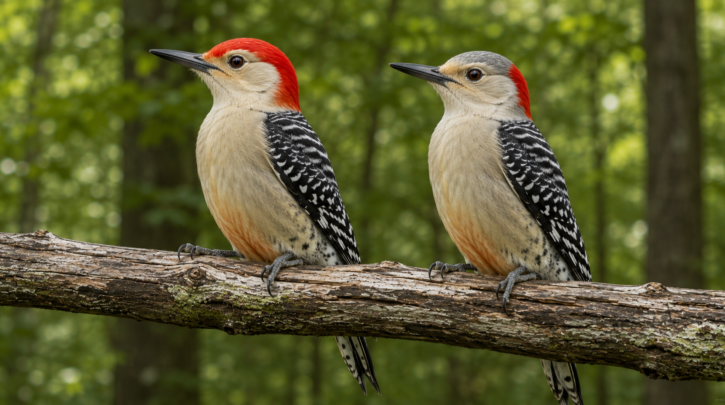

Woodpecker sexual dimorphism is subtler than in most backyard birds — body pattern, size, and overall coloring are usually identical between males and females of the same species. The difference almost always comes down to a small patch of red on the head, present in males and reduced or missing in females.
Downy Woodpecker
Male: small red patch on the back of the head (nape). Female: no red at all, otherwise identical in pattern and size.
Hairy Woodpecker
Male: red nape patch, in the same location as a Downy’s. Female: no red. The sexing rule is identical to Downy — only size and bill length, covered in our identification guide, separate the two species regardless of sex.
Red-bellied Woodpecker
Male: red extends from the bill over the entire crown to the nape, a continuous cap of color. Female: red is limited to the nape only, with a plain gray crown — a clearly reduced amount of red rather than a total absence.
Northern Flicker
Male: a bold mustache stripe (malar stripe) running from the base of the bill — black in the eastern Yellow-shafted form, red in the western Red-shafted form. Female: no mustache stripe at all, otherwise identical plumage.
Pileated Woodpecker
Male: red forehead extending to the bill, plus a red mustache stripe. Female: black forehead and a black mustache stripe instead of red — both sexes keep the flaming red crest, so the forehead and mustache color are what to check, not the crest itself.
A Consistent Pattern Across the Family
Notice the theme: in every one of these five species, body size, back pattern, and overall coloring are the same between sexes. Only a specific head marking — nape patch, crown extent, mustache stripe, or forehead color depending on species — differs. This is a meaningfully different pattern from a bluebird, where males and females differ in overall color saturation across the whole body, or an oriole, where males show extensive black the females lack entirely.
Behavior Can Help Too
During nest excavation, both sexes participate directly, unlike an oriole nest built almost entirely by the female — so watching who’s excavating won’t reliably indicate sex the way it can for other bird species. Drumming, on the other hand, is performed by both sexes as well, though males often drum somewhat more frequently during territory establishment.
Juveniles
Young woodpeckers of both sexes typically show a messier, more diffuse patch of red on the crown immediately after fledging, which resolves into the adult male or female pattern — or disappears entirely for females — within the first several months of life.
Curious what drumming actually sounds like species to species? See our drumming and calls guide.
Why Head Markings Specifically
Ornithologists generally attribute the concentration of sexual dimorphism in the head region, rather than across the whole body the way it appears in bluebirds or orioles, to the fact that woodpeckers already spend so much time facing potential mates and rivals head-on during territorial drumming and cavity-entrance displays. A visible marking concentrated where it’s most likely to be seen during these face-forward interactions may simply be more efficient than dimorphism spread across the whole body.
Comparing to Other Bird Species
This head-only pattern is genuinely distinct from every other species. Bluebirds differ in overall color saturation across the entire body. Orioles differ by the presence or absence of extensive black plumage. Woodpeckers differ by a single, specific head marking while everything else — back pattern, wing pattern, overall size — stays identical between the sexes.
Field Practice: Testing Yourself
A useful exercise for building confidence with this pattern is deliberately checking the head first on any woodpecker sighting, rather than defaulting to overall color impression the way you might with a more broadly dimorphic species. Once the head-marking habit becomes automatic, sexing most woodpecker sightings ends up taking little more than a second or two of focused looking.
Why This Matters for Nest Monitoring
Because both sexes participate directly in cavity excavation and later in feeding chicks, being able to quickly sex a bird visiting an active nest tree helps confirm that both parents remain present and active, rather than one having been lost to a predator partway through the nesting attempt. This kind of quick, careful visual check is a genuinely useful, low-disturbance way to monitor ongoing progress from a distance without ever needing to approach the cavity itself or risk disturbing an active, still-growing brood inside.