
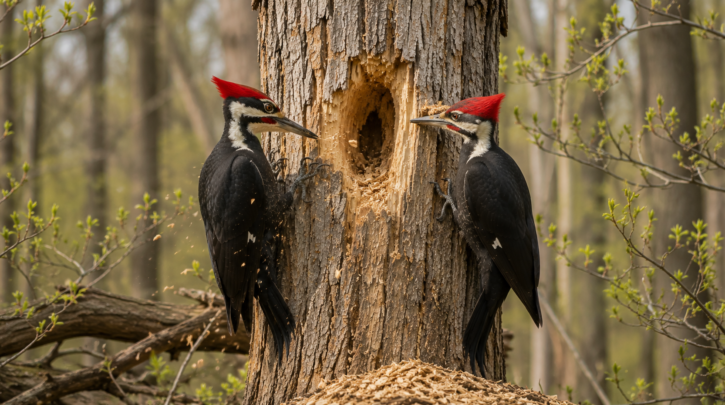

Because most common backyard woodpeckers are year-round residents already present through winter, spring isn’t an arrival season the way it is for orioles — it’s when quiet winter territories suddenly become loud, active, and focused on courtship and excavation.
This site participates in affiliate programs. If you buy through a link on this page, we may earn a commission at no extra cost to you. Affiliate disclosure
Peak Drumming Season
Drumming activity peaks in late winter and early spring as resident birds re-establish territories and attract mates. See our drumming guide for how to tell species apart by cadence — spring is the best time of year to practice this, since drumming is more frequent and more audible than at any other point in the calendar.
Pairing
Because most species maintain fairly strong territory fidelity year-round, pairing in spring often involves birds that spent the winter in loose proximity rather than birds meeting for the first time. See our FAQ for more on how resident lifestyle supports longer-term pair bonds compared to a migratory species that separates for months.
Excavation Begins
Once paired, both sexes begin excavating a fresh cavity, typically choosing dead or dying wood for the reasons covered in our nest cavity guide. A pile of fresh wood chips accumulating at the base of a tree is one of the clearest early signs that a pair has chosen a specific site.
How Long Excavation Takes
Depending on species and wood hardness, excavation typically takes one to several weeks, with smaller species like Downy Woodpecker generally finishing faster than larger species like Pileated Woodpecker working a proportionally larger chamber.
First Eggs of the Season
Once the cavity is complete, egg laying typically follows within days. See our eggs guide for clutch size and the notable male-night-shift incubation pattern that sets this family apart from bluebirds and orioles.
Watching for Starling Competition
Spring is also when European Starlings are most likely to attempt taking over a Northern Flicker cavity, since Flicker holes are large enough for starlings to use. See our predator guide for how to recognize this specific threat.
Once eggs appear, see our guide to baby woodpeckers and fledging for the longer nestling period that follows.
Regional Timing
Exact spring timing varies by latitude, with southern populations generally beginning courtship and excavation earlier than northern ones. Because these species are resident rather than migratory, though, the shift is more a gradual seasonal ramp-up in existing birds’ behavior than the sudden population turnover a migratory species shows on arrival.
Weather Setbacks in Early Spring
A late cold snap or unseasonable storm can temporarily delay excavation, particularly for northern populations where spring weather is more variable. Because woodpeckers aren’t racing a migration-driven calendar the way an oriole is, a short delay of this kind generally has less consequence for the overall season than it would for a species working with a much tighter window.
Monitoring an Active Cavity From a Distance
Once a cavity appears complete, watching for regular adult visits and incubation exchanges from a comfortable distance is the standard way to confirm activity without disturbing the pair. See our binoculars guide for optics that make this kind of distant monitoring easier.
What a Smooth Spring Sets Up
Because most pairs raise only one brood per season, a smooth, undisturbed spring — a well-chosen excavation site, minimal starling pressure for Flicker pairs specifically, and reasonable weather — matters just as much here as it does for a single-brooded species like an oriole, even without the added pressure of a migration deadline.
Comparing Spring to Other Species
Spring looks fundamentally different depending on which species a host is watching. An oriole host’s spring is defined by anticipation — watching for a specific arrival date after months of complete absence. A woodpecker host’s spring is more of a volume change than a presence change: the same birds that were quietly present all winter simply become dramatically louder and more visible as courtship and excavation take over.
A Good Time to Confirm Local Species
With drumming at its loudest and most frequent, spring is genuinely the easiest time of year to confirm exactly which of the five common species are present on a property, since the species-specific drum patterns covered in our drumming guide are both more frequent and easier to hear clearly than at any other point in the year.
Preparing Feeders Ahead of the Nesting Push
Keeping a suet feeder well stocked through spring supports adults during the energy-intensive excavation and early incubation period, even though feeder activity typically isn’t at its absolute peak until winter. A reliable food source nearby can meaningfully reduce the distance and time parents spend foraging once chicks eventually hatch.
Alongside suet, a camera feeder like the Birdfy Feeder Metal 2 4K offers sunflower seed and records every visit, so you can see which woodpeckers are coming in.