
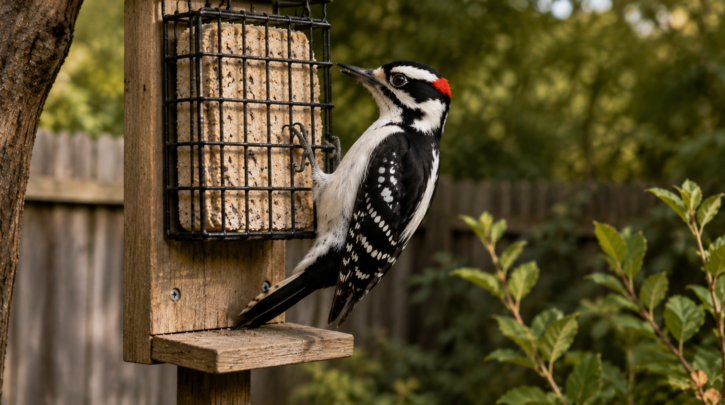

A woodpecker feeder needs to account for two things almost no other backyard feeder has to worry about: a foot structure built for climbing rather than perching, and a stiff tail that functions as a genuine physical prop while feeding.
Zygodactyl Feet: Built for Climbing
Most perching songbirds have three toes forward and one back. Woodpeckers instead have a zygodactyl arrangement — two toes forward, two back — which provides a much stronger grip on vertical bark than a typical songbird foot. This is exactly why woodpeckers cling comfortably to a vertical suet cage or tree trunk in a way most other backyard birds can’t manage nearly as well.
The Tail as a Third Leg
A woodpecker’s tail feathers are unusually stiff and pointed compared to most songbirds, and they’re braced directly against bark or a feeder surface while the bird feeds, functioning almost like a third leg for stability. This is why the best woodpecker feeders include a tail-prop board — a flat surface below the suet cage that mimics a tree trunk — rather than leaving the bird to balance on the cage alone.
Why Tail-Prop Design Matters
A feeder without a tail-prop still works, but a woodpecker feeding on it has to rely entirely on foot grip rather than the natural brace-and-climb posture it would use on an actual tree. Feeders with a dedicated prop board tend to see longer, more relaxed feeding visits, since the bird can settle into its natural feeding stance.
Cage Material and Durability
Metal wire cages hold up far better than plastic-coated alternatives against the genuine force of a woodpecker’s bill, which is built to excavate solid wood and can damage weaker feeder materials over time. A sturdy metal cage is worth the modest extra cost for anything expected to survive a full season of regular use.
Placement Tips
- Mount on or near an actual tree trunk where possible, giving the bird a natural approach and familiar surroundings
- Position in partial shade to slow suet spoilage in warm weather
- Keep some distance from dense shrubbery that could hide an ambush predator
- Avoid ground-level placement, which invites squirrels and other ground foragers more readily than an elevated feeder
Beyond Suet: Other Feeder Types
Peanut feeders — wire mesh tubes filled with whole or shelled peanuts — are another genuinely effective option that draws multiple woodpecker species alongside suet, and some hosts run both side by side to offer variety.
Cleaning and Maintenance
Suet cages should be checked regularly for mold or spoilage, particularly in warm weather, and wiped down between refills. A tail-prop board benefits from occasional cleaning as well, since it accumulates the same grime and residue as the cage itself over a season of use.
Pair a feeder with retained dead wood on your property for the biggest impact — see our attracting guide for the bigger habitat picture beyond the feeder itself.
Feeder Shape and Orientation
Vertical, elongated cages that mimic the shape of a tree trunk or branch tend to be used more naturally than compressed or unusually shaped alternatives, since they let a woodpecker adopt a feeding posture close to what it would use on an actual tree. A tall, narrow cage generally outperforms a short, wide one for this reason, even at the same total suet capacity.
Multiple Feeders for Multiple Species
Because Downy, Hairy, Red-bellied, and Pileated Woodpeckers all differ meaningfully in size, a single feeder sized for a Downy can feel cramped or awkward for a much larger Pileated. Larger properties sometimes run two feeder sizes — a compact cage for the smaller species and a larger, more robust cage capable of handling a Pileated’s size and feeding force without damage.
Combining Suet With Other Foods
Some feeder designs combine a suet cage with an adjacent seed tray or peanut compartment, letting a single feeding station serve woodpeckers alongside other backyard birds. This can increase overall traffic, though it’s worth monitoring whether the added seed component is drawing in more squirrel activity than the suet alone would.
Mounting Height
A height of roughly five to eight feet off the ground works well for most yards — high enough to discourage casual ground-predator access, low enough for comfortable viewing and easy refilling without requiring a ladder or step stool for routine maintenance and cleaning visits.
Seasonal Feeder Adjustments
Winter is typically the peak season for suet feeder activity, since natural insect prey is hardest to find during the coldest months, so it’s worth checking and refilling more frequently through this stretch than during the rest of the year. Spring and summer visits tend to taper somewhat as natural food becomes more abundant, though a well-established feeder generally continues seeing at least some regular traffic year-round from resident birds already familiar with the location.