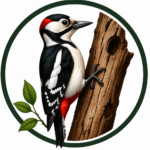

Most identification guides — including our own — anchor on five species: Downy, Hairy, Red-bellied, Northern Flicker, and Pileated. There’s a sixth backyard regular that gets left out more often than it should: the Yellow-bellied Sapsucker.
It’s not rare, and it isn’t subtle once you know what you’re looking for, but its habits are different enough from the other five that it tends to get filed under “some kind of woodpecker” rather than identified outright.
Why It Gets Overlooked
Part of the problem is the name. A lot of people assume anything drilling neat rows of holes in a tree is either damaging the tree or is some other pest entirely, not a woodpecker at all. The other part is range and season: Yellow-bellied Sapsuckers breed across Canada and the northern US, then move south for winter (more on that in our migration guide), so in much of the country they’re a seasonal visitor rather than a year-round fixture the way a Downy Woodpecker is.
Field Marks
Adult Yellow-bellied Sapsuckers are roughly Hairy Woodpecker-sized — about 8 to 9 inches — with a black-and-white barred back pattern that reads more finely striped than the bold black-and-white blocks of a Downy or Hairy. The chest carries a pale yellow wash that gives the species its name, though it’s subtle and not always the most useful field mark in the field. A long white wing stripe running down the folded wing is more reliable and visible at a distance.
The head pattern is the fastest confirmation. Males show a red forehead patch and a red throat; females have the same red forehead but a white throat. Both sexes show a black-and-white face pattern with a black bib across the upper chest — distinct from the solid red cap of a male Downy or Hairy, and nothing like the mostly-gray head of a Red-bellied Woodpecker.
| Feature | Yellow-Bellied Sapsucker | Hairy Woodpecker | Downy Woodpecker |
|---|---|---|---|
| Size | 8-9 in | 9-10 in | 6-7 in |
| Back pattern | Fine horizontal barring | Solid white stripe down back | Solid white stripe down back |
| Throat | Red (male) / white (female) | White | White |
| Chest | Pale yellow wash | White | White |
| Signature sign | Neat rows of sap wells | Larger excavation holes | Small excavation holes |
The Giveaway Sign: Sap Wells
Even when the bird itself is out of sight, Yellow-bellied Sapsuckers leave a calling card no other backyard woodpecker produces: horizontal rows of small, evenly spaced holes drilled into live tree bark, usually on birch, maple, or fruit trees. These sap wells aren’t feeding damage in the excavation sense — the bird isn’t digging for insects inside the wood. It’s tapping the tree the way a person might tap a maple for syrup, then returning repeatedly to drink the sap and eat any insects the sap attracts. See our full woodpecker diet guide for how this compares to the insect-and-suet diet of the other five species.
If you see a grid or a ring of small holes circling a trunk with no evidence of bark being stripped away, that’s almost certainly sapsucker work rather than damage from Downy or Hairy Woodpeckers, which excavate deeper, more irregular holes when hunting for larvae under bark.
Range and Where You’re Likely to See One
Yellow-bellied Sapsuckers breed across most of Canada and the northeastern US, then winter through the southeastern states, Mexico, and Central America. That means birders in the northern half of the country see them mainly as summer breeders, while birders in the South see them mainly as winter visitors — one of the only true seasonal-turnover patterns among common backyard woodpeckers, most of which are year-round residents. Our habitat and range guide covers how this compares to the mostly non-migratory pattern of the other five species.
Confirming an ID: Calls
Sapsuckers have a distinctive, slightly nasal mewing call, quite different from the sharp “peek” of a Downy or the rattling call of a flicker. They also drum in a recognizable irregular, stuttering pattern — a burst followed by a few isolated taps — rather than the steady even roll typical of Downy and Hairy Woodpeckers. Our drumming and calls guide breaks down how to tell species apart by sound alone, which is often faster than getting a clean visual.
Quick Reference Checklist
- Fine horizontal back barring, not bold black-and-white blocks
- Red forehead patch on both sexes; red throat on males only
- Pale yellow wash on the chest (subtle, not always visible)
- Long white wing stripe visible on the folded wing
- Neat horizontal rows of small holes on live tree bark nearby
- Present as a breeder in the north, a winter visitor in the south
Once you’ve picked out the sap wells and the barred back pattern, a Yellow-bellied Sapsucker stops looking like “some kind of woodpecker” and becomes one of the easier species in the family to confirm at a glance.
Similar Species and Regional Confusion
Two close relatives can complicate identification in parts of the country. The Red-naped Sapsucker and Red-breasted Sapsucker, both found in the western US, were once considered the same species as the Yellow-bellied Sapsucker and share the same sap-well feeding behavior and similar body shape. Range is the most reliable separator: Yellow-bellied Sapsuckers are the only member of this group found east of the Great Plains, so a sapsucker seen anywhere in the eastern half of the country can be identified to species by range alone, without needing to sort through the subtler plumage differences that separate the three western relatives from each other.
Juveniles and Fall Plumage
Young Yellow-bellied Sapsuckers in their first fall look noticeably duller and browner than adults, lacking the crisp red forehead patch and showing a mottled brownish-gray head and chest instead of the clean black-and-white adult face pattern. This can make a juvenile bird genuinely hard to place on first look, especially since fall is also when young birds are dispersing and may show up in yards that don’t typically host sapsuckers. The barred back pattern and the long white wing stripe remain reliable even on a juvenile bird, so leaning on those two field marks rather than head coloring is the more consistent approach until a bird molts into adult plumage the following year.