
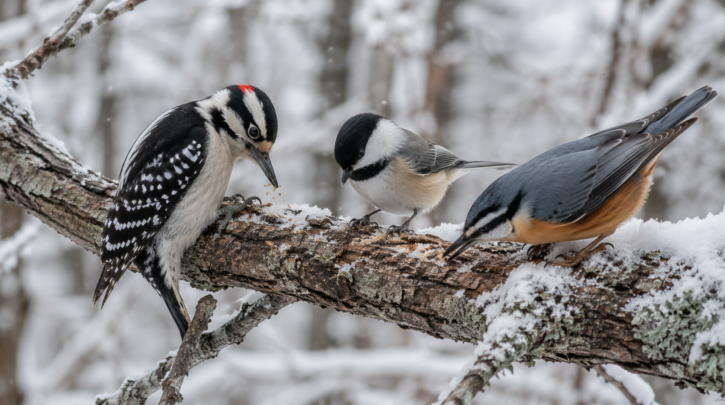

Winter is where the woodpecker family’s year-round residency really pays off — unlike an oriole host facing a completely empty season, a woodpecker host can expect steady activity right through the coldest months.
This site participates in affiliate programs. If you buy through a link on this page, we may earn a commission at no extra cost to you. Affiliate disclosure
Sheltering in Roost Cavities
The dedicated roost cavities excavated in fall get put to direct use through winter, providing enclosed, insulated shelter overnight during cold weather. This is a genuine advantage available to woodpeckers that most other backyard birds simply don’t have access to, since they can’t create this kind of shelter for themselves.
Joining Mixed-Species Foraging Flocks
Outside the strictly territorial breeding season, woodpeckers — particularly Downy Woodpecker — often join mixed-species foraging flocks alongside chickadees, titmice, and nuthatches through winter. Traveling with a mixed flock offers better collective predator detection and can improve foraging efficiency compared to searching for food alone.
Why Mixed Flocking Works
Each species in a mixed winter flock forages slightly differently — a woodpecker working bark crevices, a nuthatch working from a different angle, a chickadee checking smaller twigs — which reduces direct competition between flock members while still providing the safety benefit of traveling in a larger, more vigilant group.
Suet Feeder Activity Peaks
Winter is when suet feeders see their heaviest use of the year, since natural insect prey is hardest to find during the coldest months. See our suet guide for keeping a station stocked through this peak-demand stretch.
Cached Nut Reliance
Red-bellied Woodpeckers in particular draw heavily on nuts and acorns cached earlier in the year during lean winter stretches, a foraging strategy that gives the species a meaningful buffer against the toughest weeks of winter that more strictly insectivorous species don’t have access to.
Late Winter: The Turn Toward Spring
As winter progresses toward its end, drumming activity begins picking up well before the calendar suggests spring has arrived, and mixed foraging flocks gradually break apart as individual birds shift attention back toward territory and courtship. See our spring guide for what comes next.
Want next season to go smoothly? Now is a good time to check that suet feeders and any nest boxes are ready — see our nest box guide for a pre-season refresh.
A Full Circle, Without the Round Trip
Unlike an oriole’s year, which spans two hemispheres and a genuine seasonal absence, a resident woodpecker’s annual cycle plays out entirely within the same general territory — drumming and courtship in spring, nesting through summer, molt and roost preparation in fall, and a steady, suet-and-cavity-supported presence through winter, all without ever really leaving.
Cold Snaps and Extreme Weather
Severe, prolonged cold can still challenge even a well-prepared resident bird, particularly when combined with ice storms that make natural food temporarily inaccessible. A consistently stocked suet feeder matters most during exactly these stretches, when the gap between available natural food and actual energy need is at its widest for the year.
Identifying Woodpeckers in Winter Flocks
Spotting a woodpecker traveling with a mixed chickadee-and-nuthatch flock is a good opportunity to practice the identification skills covered in our identification guide, since the smaller birds in the flock provide a useful size reference for judging the woodpecker’s own scale at a glance.
What Backyard Hosts Can Do
- Keep suet feeders stocked and checked more frequently through the coldest stretches
- Leave nest boxes and roost-friendly dead wood in place through winter rather than removing them
- Provide a reliable water source, since natural water can freeze over for extended periods
- Watch for mixed foraging flocks passing through, which often include more species than a single feeder visit alone would reveal
A camera feeder like the Birdfy Feeder Metal 2 4K is a good way to see which species are passing through, since it records and identifies every visitor, even when you’re not watching.
Winter Identification Practice
Winter plumage looks essentially the same as breeding plumage across all five common species, so the identification approach covered in our species identification guide applies just as well in January as in May. What changes is context — a winter sighting is more likely to involve a bird traveling with a mixed flock than one drumming alone on a territory.
A Genuinely Different Winter Than Other Species
Where a bluebird host might watch several birds huddle overnight in a nest box and an oriole host sees nothing at all, a woodpecker host gets a steady, visible presence supported by a shelter system the bird built entirely for itself — arguably the most self-sufficient winter survival strategy of any species.
Looking Back at a Full Year
From drumming and excavation in spring, through a long, protected nestling period in summer, a quiet molt and roost-cavity preparation in fall, and a steady, self-sufficient winter, the woodpecker year is defined less by dramatic seasonal change than by consistency — the same birds, the same general territory, adapting behavior rather than location as the calendar turns.