
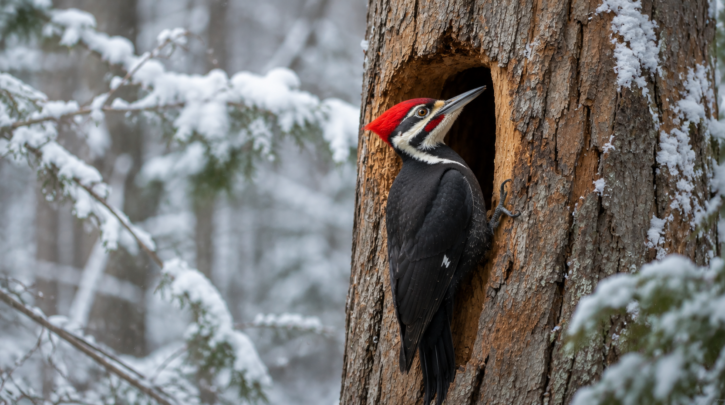

This is the one place where woodpeckers stand apart from every other species. Bluebirds show partial migration. Orioles undertake a genuine long-distance migration to the tropics. Most common backyard woodpeckers do neither — they simply stay put.
A Largely Resident Family
Downy, Hairy, Red-bellied, and Pileated Woodpeckers are essentially year-round residents throughout their range, present in the same general territory in January as in July. This isn’t a partial pattern with some populations migrating and others not, the way bluebirds show it — it’s a consistent, non-migratory strategy across nearly the entire range of these four species.
The Exception: Some Northern Flickers
Northern Flicker is the one species on this list that shows any meaningful migratory movement, and even then it’s partial rather than universal — the northernmost populations breeding in Canada and Alaska shift south for winter, while the bulk of the species’ range across the lower 48 states remains resident year-round.
Why Staying Put Works
A diet that includes stored nuts, ground-foraged ants (for Flickers specifically), and a wide range of overwintering insect larvae accessible through excavation gives these species enough year-round food security that migration simply isn’t necessary the way it is for a species with a more insect-dependent diet in the warmer months, like an oriole.
Cavity Roosting: A Resident-Only Advantage
Because woodpeckers can excavate their own shelter, they have an option most other backyard birds lack: a dedicated roost cavity used purely for overnight shelter during cold weather, separate from any active nest cavity. This ability to create warm, enclosed winter shelter on demand is part of what makes year-round residency a genuinely viable strategy in climates that would be difficult to survive without it.
Local Movement vs. True Migration
Even fully resident populations sometimes show small-scale seasonal movement — shifting to lower elevations, moving between habitat patches, or concentrating more heavily around reliable food sources like suet feeders during the leanest winter weeks. This kind of local shuffling is distinct from true migration and doesn’t involve leaving the general territory the way a migratory species does.
What This Means for Backyard Hosts
Because most of these species are present year-round, a suet feeder and retained dead wood pay off across every season rather than only during a narrow migratory or breeding window — a genuinely different hosting relationship than the seasonal anticipation involved in supporting an obligate migrant like an oriole.
Want to know what a resident woodpecker’s year actually looks like? See our seasonal guides, starting with woodpeckers in winter.
How This Compares to Other Species
Three sites, three genuinely different migration strategies. Bluebirds show partial migration, with some populations staying resident and others moving a modest distance seasonally. Orioles undertake an obligate long-distance migration that empties North America of nearly the entire population each winter. Woodpeckers, for the most part, simply don’t migrate at all — a third distinct pattern that makes this the only one of the three families where “does it migrate” has a mostly straightforward no as the answer.
Why Comparing Strategies Matters
Understanding which strategy a given species uses changes what supporting it actually looks like — feeding a resident woodpecker population is a year-round commitment with steady, predictable demand, while supporting a migratory oriole population means concentrating effort around two intense seasonal windows and largely stepping back the rest of the year.
Tracking Local Presence Year-Round
Because most of these species are non-migratory, keeping informal notes on which individuals or pairs are present through a full calendar year, rather than just during a breeding season, can reveal genuinely interesting territory-fidelity patterns over time — the same pair, or their offspring, often remaining in a recognizable area across multiple years.
A Reliable Presence Worth Planning Around
Because there’s no seasonal arrival or departure to anticipate the way there is with orioles, planning feeder placement and dead-wood retention around a resident woodpecker population can happen on whatever timeline suits the host, without needing to coordinate around a narrow migratory window that closes for months at a time each year.
Setting Realistic Expectations
A new host shouldn’t expect a sudden burst of woodpecker activity tied to a specific calendar date the way an oriole host might anticipate a spring arrival window — resident species are discovered and adopted gradually, often over multiple seasons, as a property’s feeding and habitat offerings become established, trusted, and familiar to the local population over time.
A Genuinely Different Kind of Relationship
Hosting a resident species ends up feeling different from hosting a migrant, even setting aside the practical feeding schedule. There’s no anticipated arrival to watch for, no farewell season to mark, just a steady, ongoing presence that becomes part of the everyday texture of a property rather than a seasonal event to look forward to and then miss once it passes.