
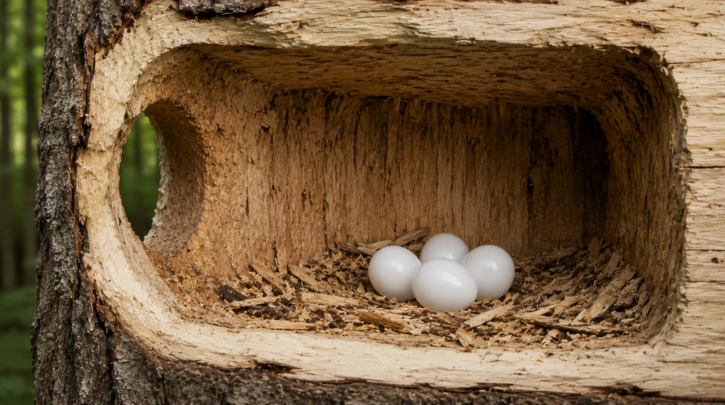

Woodpecker eggs are about as visually simple as eggs get — plain white, with no markings at all — but the incubation routine behind them includes a detail that sets this family apart from almost every other species.
Egg Color
Woodpecker eggs are glossy white and completely unmarked, a pattern shared by many cavity nesters that don’t need camouflage inside a fully enclosed, dark chamber. This is broadly similar to the plain pale-blue eggs of a bluebird, though woodpecker eggs skip the blue tint entirely in favor of pure white.
Clutch Size by Species
- Downy Woodpecker: typically 4 to 5 eggs, with a documented range of 3 to 8
- Hairy Woodpecker: a similar range to Downy
- Red-bellied Woodpecker: typically 4 to 5 eggs
- Northern Flicker: notably larger, typically 5 to 8 eggs
- Pileated Woodpecker: typically 3 to 5 eggs, on the smaller end despite the species’ large body size
Incubation: A Genuine Departure From Other Species Pattern
Other species like bluebirds, and orioles, leaves incubation entirely to the female. Woodpeckers don’t follow that pattern at all: both parents incubate, and in most species, the male specifically takes the overnight shift while both sexes share daytime incubation duties.
Why Male Night Incubation Is Notable
This division of labor is genuinely unusual among North American backyard birds, and it reflects a broader pattern of shared parental investment across the woodpecker family that extends well beyond incubation into excavation, feeding, and general nest defense — a more evenly split partnership than the female-dominated incubation seen in most of the other species.
Incubation Duration
Incubation length varies by species, generally running somewhere in the range of 11 to 18 days, with smaller species like Downy Woodpecker incubating faster than larger species like Pileated Woodpecker — a size-correlated pattern consistent with incubation timing across birds broadly.
What’s Happening Inside a Cavity You Can’t See
Because the nest is fully enclosed inside solid wood, direct observation of eggs is rarely possible without specialized equipment. Watching adult activity — regular exchanges at the entrance hole as incubating parents swap shifts — is the most practical way to confirm an active nest without disturbing it.
Eggs about to hatch? See our guide to baby woodpeckers and fledging for what happens next.
Why White, Unmarked Eggs Are Common in Cavity Nesters
The plain white, unmarked pattern shared by woodpecker and bluebird eggs alike reflects a straightforward evolutionary logic: camouflage matters far less inside a fully enclosed, dark cavity than it does in an open nest exposed to direct view. Species that nest in the open, like orioles, tend to show scrawled or blotched markings that provide camouflage against a visually exposed background — a pattern that simply isn’t necessary once a nest is hidden entirely inside solid wood.
How Egg Timing Relates to Cavity Completion
Egg laying typically begins within a few days of cavity completion, once the chamber has reached sufficient depth and the wood-chip lining at the bottom has accumulated enough to provide a stable surface. A pair that’s still actively excavating hasn’t yet reached the point where eggs would appear, even if the entrance hole itself looks essentially finished from outside.
Confirming an Active Nest Without Direct Access
Because eggs themselves are essentially never visible without specialized cavity cameras or invasive inspection, confirming an active nest generally relies on behavioral cues: regular adult visits to a specific cavity entrance, incubation exchanges between the male and female shift, and eventually the begging calls of hatched chicks audible from outside.
A Note on Cavity Cameras
Unlike a bluebird box, which can be fitted with a simple internal camera relatively easily, monitoring inside an active woodpecker cavity typically requires drilling into solid, occupied wood — a level of intervention most hosts reasonably avoid given the disturbance risk. External behavioral observation remains the standard, lower-impact approach for this species, and it’s usually enough to confirm activity without ever needing to see inside directly.
Comparing Egg Biology to Other Species
The plain white egg and shared-incubation pattern together make woodpeckers a genuine outlier compared to other species. Bluebirds lay plain pale-blue eggs with female-only incubation; orioles lay scrawled, camouflaged eggs, also with female-only incubation. Woodpeckers combine the plain, unmarked egg color typical of cavity nesters with a shared, both-sexes incubation routine found in neither of the other two families — a combination that reflects just how differently this family has evolved to raise young compared to typical open- or existing-cavity nesting songbirds.