
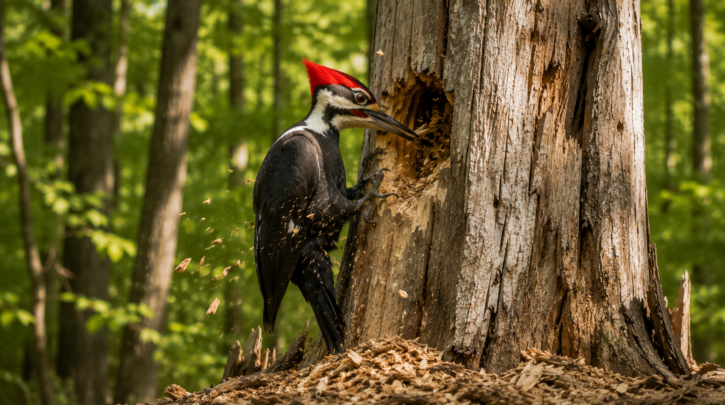

Every other species either uses an existing cavity, like a bluebird, or weaves a hanging nest, like an oriole. Woodpeckers do neither — they carve their own nesting chamber directly out of solid wood, from scratch, nearly every single year.
Choosing a Site
Dead or dying wood is strongly preferred over healthy, living wood, simply because it’s far softer and easier to excavate. Standing dead trees (snags), dead limbs on an otherwise living tree, and occasionally utility poles all serve as excavation sites, with species-specific preferences for height and surrounding habitat.
The Excavation Process
Both sexes participate directly in excavation, taking turns chiseling away wood chips with the bill and carrying or dropping the debris away from the growing cavity. A pile of fresh wood chips accumulating at the base of a tree is one of the most reliable signs that active excavation is underway nearby, often visible before the cavity opening itself is easy to spot.
How Long It Takes
Excavation time scales with both species size and wood hardness — a Downy Woodpecker can complete a cavity in roughly one to two weeks, while a Pileated Woodpecker, excavating a considerably larger chamber, typically takes longer. Softer, more decayed wood speeds the process regardless of species.
Cavity Shape and Entrance Size
The finished cavity is typically flask- or gourd-shaped — a relatively narrow entrance hole opening into a wider chamber below, which helps protect the contents from reaching predators. Entrance hole diameter scales directly with species size:
- Downy Woodpecker: roughly 1¼ inches
- Hairy Woodpecker: roughly 1½ inches
- Red-bellied Woodpecker: roughly 2 inches
- Northern Flicker: roughly 2½ to 3 inches
- Pileated Woodpecker: 3 to 4 inches or larger, often oval or rectangular rather than perfectly round
No Nest Material Added
Unlike a bluebird’s grass cup or an oriole’s woven pouch, woodpeckers add no nest material at all. Eggs are laid directly on the accumulated wood chips left over from excavation, which provide a naturally insulating, cushioned surface at the bottom of the chamber without any additional construction.
Every other species either finds a cavity or weaves a nest. A woodpecker carves its own nursery directly out of solid, standing wood.
Why a New Cavity Almost Every Year
Unlike bluebirds reusing the same box for multiple broods in a season, or even returning to a familiar general nest site, woodpeckers typically excavate an entirely new cavity for each breeding attempt, rarely reusing the same hole in consecutive years. Red-bellied Woodpeckers are a partial exception, occasionally reusing a cavity, but fresh excavation is the norm across the group.
Why This Behavior Exists
Researchers generally attribute this pattern to parasite and pathogen buildup in a cavity that’s been occupied through a full nesting cycle, along with the fact that a fresh cavity in solid, less-decayed wood offers better structural protection than a hole that’s already been weakened by a previous season of use and subsequent weathering.
What Happens to the Old Cavity
Because a completed cavity is abandoned after just one or two nesting seasons, it becomes available real estate for an entire community of birds that can’t excavate their own — including bluebirds. See our old cavities guide for the full picture of how much this single behavior supports across a local ecosystem.
Once a cavity is finished, eggs typically follow within days — see our eggs guide for clutch size and incubation details.
Excavation as a Learned Skill
Young woodpeckers don’t excavate efficiently on their first attempt — the coordination and technique involved in effective excavation improves with practice over a bird’s first year or two, which is part of why first-time breeders sometimes take noticeably longer to complete a cavity than experienced adults working the same species and wood type.
Choosing the Right Aspect and Height
Beyond wood softness, most species show some preference for entrance orientation and cavity height, often favoring an angle that reduces direct rain exposure and a height that balances predator avoidance against the physical demands of repeated trips to and from the cavity during the feeding period that follows hatching. Height preferences vary considerably by species, with larger species generally selecting higher, more substantial trees capable of supporting a larger excavated chamber.
The Energy Cost of Excavation
Excavating a fresh cavity every year is a genuinely significant energy investment, especially for larger species carving a correspondingly larger chamber. This cost is part of why dead and dying wood, which is dramatically easier to excavate than healthy living wood, is so strongly preferred — a pair excavating in already-softened wood can complete a cavity in a fraction of the time and effort required in denser material.
Multiple Cavities in a Single Territory
Beyond the active nest cavity, many woodpeckers also excavate separate roost cavities used purely for shelter outside the breeding season, meaning a single territory can contain several excavated holes at different stages of use and abandonment at any given time, not just one active nest.