
A woodpecker’s bill gets most of the attention, but the tongue is doing the real work. Nearly everything about how these birds eat — and what they’re capable of eating — comes down to a genuinely strange piece of anatomy most people never think about.
The Core Diet: Wood-Boring Insects
Beetle larvae, carpenter ants, and other insects living inside bark and dead wood make up the bulk of the diet for most species. Woodpeckers locate prey by sound and by probing, then excavate through bark and wood to reach tunnels and galleries most other birds can’t access at all.
The Tongue: A Genuinely Strange Tool
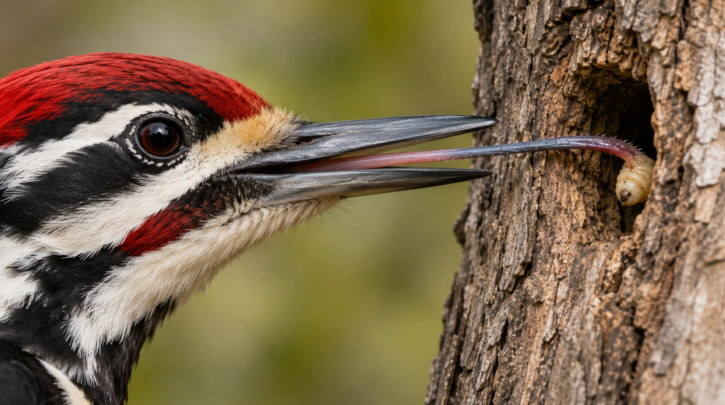
A woodpecker’s tongue is extraordinarily long relative to its body — long enough that it doesn’t simply retract into the mouth the way a human tongue does. Instead, it wraps around the back of the skull via a specialized structure called the hyoid apparatus, coiling around the braincase before extending forward. The tip is barbed and coated in sticky saliva, built specifically for spearing and extracting insect larvae from deep inside narrow tunnels.
Pileated Woodpecker: A Carpenter Ant Specialist
The Pileated Woodpecker in particular relies heavily on carpenter ants, and its large, rectangular excavation holes are often targeted directly at ant galleries deep inside dead wood — a big part of why this species leaves such distinctly larger excavation damage than the smaller woodpeckers on this list.
Northern Flicker: The Ground-Foraging Exception
Unlike the other four common backyard species, Northern Flickers spend a large share of their foraging time on the ground rather than working tree bark, digging for ants with a slightly curved bill suited to soil rather than wood. This behavior is unusual enough among woodpeckers that a Flicker on a lawn is sometimes mistaken for an entirely different kind of bird by people unfamiliar with the species.
Beyond Insects
- Fruit and berries, taken opportunistically across most species
- Nuts and acorns — Red-bellied Woodpeckers in particular cache acorns and other nuts into bark crevices for later use
- Tree sap, more central to the diet of sapsuckers, close relatives of the five species covered on this site, than to Downy, Hairy, Red-bellied, Flicker, or Pileated specifically
Suet as a Feeder Substitute
Suet isn’t a natural food, but its high fat and protein content closely mimics the energy density of the insect larvae woodpeckers naturally seek out, which is exactly why it works so well as a feeder attractant. See our suet guide for how to offer it well.
Everything about how a woodpecker eats traces back to one piece of anatomy: a barbed, sticky tongue long enough to wrap around the back of its own skull.
Seasonal Diet Shifts
Insect availability drops sharply in winter, pushing most species toward a higher reliance on cached nuts, remaining fruit, and feeder suet during the coldest months. This is when a well-stocked suet feeder tends to see its heaviest activity of the year.
Ready to set up a feeder? See our feeder setup guide for the design details that make suet genuinely accessible to woodpeckers.
Why Pesticide Use Matters
Because insects make up such a large share of the natural diet for most of the year, heavy pesticide use directly reduces the food supply woodpeckers depend on, particularly the wood-boring beetle larvae and carpenter ants that most species rely on most heavily. Retaining dead or dying trees wherever it’s safe to do so preserves this food source far more effectively than any feeder can replace on its own.
How Woodpeckers Find Hidden Prey
Locating insects buried inside solid wood, invisible from the outside, requires more than random excavation. Woodpeckers are believed to detect the presence of larvae and tunnels partly by sound — tapping and listening for subtle differences in resonance between solid wood and wood that’s been hollowed out by insect activity — and partly by visual and behavioral cues like exit holes, sawdust, or sap flow that signal insect activity underneath the bark.
Why Dead Wood Specifically Matters
Live, healthy wood is far too dense and resistant for most insects to bore into easily, which is exactly why dead and dying trees host so much more insect activity than living ones — and why those same dead trees are disproportionately important as woodpecker feeding grounds. A property that removes dead wood promptly is inadvertently removing the majority of natural woodpecker food along with it.
Diet Differences Across the Five Species
While insects dominate for all five common backyard species, the exact balance shifts meaningfully. Downy and Hairy Woodpeckers stay closely tied to bark-dwelling insects year-round. Red-bellied Woodpeckers show the most omnivorous diet of the group, readily taking nuts, fruit, and suet even when insects are plentiful. Northern Flickers lean unusually heavily on ground ants. Pileated Woodpeckers concentrate heavily on carpenter ants specifically, reflected in their distinctively large excavation holes.