
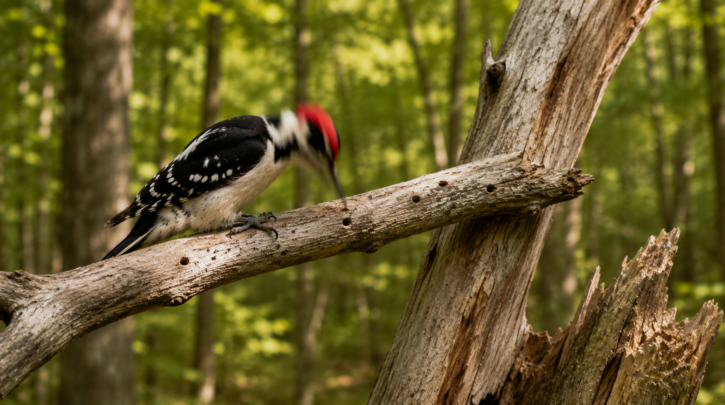

The rapid-fire hammering sound most people associate with woodpeckers usually isn’t feeding at all — it’s drumming, a purely mechanical form of communication with no vocal component, and it means something very different from the irregular tapping a woodpecker makes while actually excavating for food.
What Drumming Actually Is
Drumming is a rapid, evenly spaced series of bill strikes against a resonant surface — dead wood, a hollow branch, or, in suburban settings, metal objects like gutters, chimney caps, and street signs. It functions as a substitute for song: a way to advertise territory and attract a mate without using the vocal cords at all, since a loud, resonant drum roll can carry just as far as a vocal call in dense woodland.
Drumming vs. Feeding Taps
Feeding taps sound noticeably different from drumming — slower, irregular, exploratory, with pauses as the bird investigates the wood or extracts prey. Drumming, by contrast, is fast, rhythmic, and evenly paced, typically lasting only a second or two per burst but often repeated many times in a session.
Species Differences in Drum Pattern
- Downy Woodpecker: a relatively slow, short drum roll
- Hairy Woodpecker: faster and longer than a Downy’s, though similar in overall quality
- Northern Flicker: a similar rapid roll, notable for a strong preference for metal objects in suburban areas, which amplify the sound considerably
- Pileated Woodpecker: loud, deep, and slow, typically accelerating at the start and trailing off toward the end — a distinctive rhythm given the bird’s large size
Experienced birders can often identify a species from drum cadence alone, without ever seeing the bird — the combination of speed, duration, and trailing pattern is genuinely diagnostic once you’ve learned to listen for it.
Vocal Calls by Species
- Downy Woodpecker: a descending, whinnying call
- Hairy Woodpecker: a sharp, loud “peek” call, similar to Downy’s but more forceful
- Red-bellied Woodpecker: a rolling, churring call
- Northern Flicker: a loud, repeated “wick-wick-wick” along with a distinct “klee-yer” call
- Pileated Woodpecker: a loud, irregular series of harsh calls, often compared to laughter given its volume and cadence
Why Drumming on Houses Happens
Metal gutters, downspouts, and chimney caps make excellent drums — louder and more resonant than most natural wood — which is exactly why woodpeckers, Northern Flickers in particular, are drawn to them during territorial season. This is drumming behavior, not feeding or nest excavation, and it typically doesn’t indicate structural damage the way excavation into siding would.
Seasonal Timing
Drumming peaks in late winter and early spring as territories are established and mates are attracted, tapering off once pairs have settled into active nesting. A sudden burst of drumming activity on your property in late winter is a strong sign a woodpecker is actively claiming territory nearby.
Dealing with unwanted drumming on your house? See our deterrent guide for options that address the behavior without harming the bird.
How Woodpeckers Avoid Concussion
Drumming at high speed against a hard surface repeatedly raises an obvious question: how does a woodpecker avoid brain injury? Specialized skull anatomy, including a spongy bone structure that absorbs shock and a tongue apparatus that wraps around the back of the skull, distributes the force of each strike in a way that prevents the kind of injury the same impact would cause in most other animals. This adaptation supports both drumming and the far more forceful strikes used during actual excavation.
Recording and Identifying Drum Patterns
For anyone wanting to get better at identifying species by drum pattern alone, recording a burst on a phone and comparing playback speed and duration against reference recordings is a genuinely effective way to train the ear, since drum patterns are often easier to compare side by side than to judge from memory alone in the moment.
Drumming Frequency and Territory Size
More frequent, sustained drumming from a single location generally indicates a smaller, more actively defended territory, while sporadic drumming spread across a wider area can suggest a bird still scouting rather than fully settled. This isn’t a precise measurement, but consistent observation over a season can give a reasonable sense of how established a resident pair has become.
Drumming as a Pair-Bonding Signal
Beyond simple territorial advertisement, mutual drumming between a paired male and female — sometimes described as duetting, where one bird answers another’s drum roll from nearby — is documented in several species and thought to help reinforce and maintain the pair bond through the nesting season, similar in function to the mutual singing and calling seen between mated pairs of many songbirds.