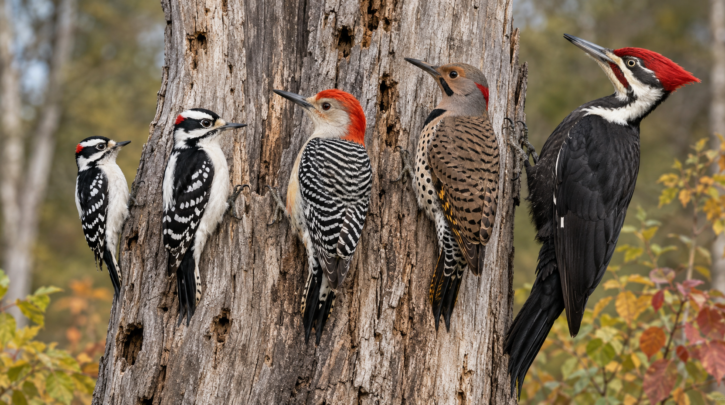

North America is home to more than 20 woodpecker species, but five make up the overwhelming majority of backyard sightings: Downy, Hairy, Red-bellied, Northern Flicker, and Pileated. Size and bill length do most of the identification work, once you know what to compare.
Downy Woodpecker
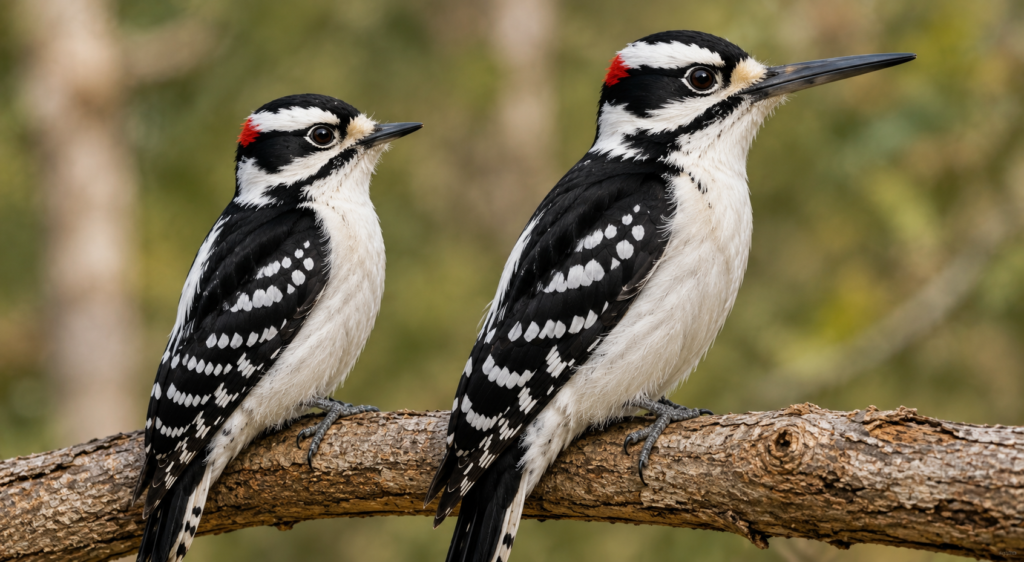
- Size: the smallest North American woodpecker, about 6 to 7 inches long
- Bill: short and stubby, noticeably shorter than the width of the head
- Pattern: black and white overall, with a white stripe down the back and white spotting on the wings
- Habitat: extremely common at backyard feeders across nearly all of the US and Canada
Hairy Woodpecker
- Size: 9 to 10 inches, noticeably larger than a Downy
- Bill: long and substantial, roughly equal in length to the width of the head
- Pattern: nearly identical black-and-white pattern to the Downy, including the white back stripe
- Habitat: less frequent at feeders than Downy, generally more wary of people
Downy vs. Hairy: The Bill Test
These two species look so alike that size and bill length are the only reliable field marks. A Downy’s bill looks short and delicate relative to its head; a Hairy’s bill looks long and substantial, nearly as long as the head itself. Without a size reference nearby, the bill proportion is the fastest way to separate the two.
Red-bellied Woodpecker
- Size: about 9 inches, similar in size to a Hairy Woodpecker
- Pattern: bold black-and-white barring across the back and wings, giving a zebra-striped look quite different from the plain white back of Downy and Hairy
- Head: red extending from the bill over the crown in males; red limited to the nape in females
- The name is a common source of confusion — the “red belly” is a faint, pale reddish wash on the underside that’s genuinely hard to see in the field, while the red on the head is obvious
Northern Flicker
- Size: 12 to 14 inches, considerably larger than the three species above
- Pattern: brown and tan overall with black barring on the back and a black-spotted breast, plus a bold black crescent across the upper chest
- In flight: a bright flash of color under the wings and tail — yellow in the eastern “Yellow-shafted” form, salmon-red in the western “Red-shafted” form
- Behavior: unusual among woodpeckers for foraging heavily on the ground, digging for ants rather than working tree bark
Pileated Woodpecker
- Size: 16 to 19 inches, nearly crow-sized and by far the largest of the five
- Pattern: mostly black body with bold white stripes down the neck and face, topped with a flaming red crest
- Sign: distinctive large, rectangular excavation holes in dead wood, considerably bigger than anything the other four species leave behind
Male vs. Female Head Markings Across Species
For all five species, the fastest way to sex an individual is checking for red on the head — present in males, reduced or absent in females. The details vary slightly by species, covered fully in our male vs. female guide.
Size and bill length separate Downy from Hairy; back pattern separates Red-bellied from both; ground-foraging behavior and underwing flash flag a Flicker; and sheer size alone identifies a Pileated.
Range Overlap
All five species broadly overlap across much of the eastern and central United States, so range alone won’t separate them the way it helps with bluebirds or orioles. Size, bill proportion, and back pattern do the real work here instead.
What to Do Once You’ve Made an ID
Identified a species drumming on a dead tree in your yard? That’s likely a territorial signal, not feeding. See our drumming and calls guide for what that behavior means, and our nest cavity guide if you suspect excavation has begun nearby.
Not sure which species is visiting your yard? Our binoculars buying guide covers the optics that make bill length and back pattern easy to see at typical backyard distances.
Juveniles
Young woodpeckers of most species show a messier, more diffuse red patch on the crown right after fledging, regardless of sex, which fades or relocates to the adult pattern within their first year. A juvenile bird with red scattered across the crown rather than concentrated on the nape or forehead is usually a young bird of either sex rather than a plumage variant worth puzzling over.
Sound as a Fast Confirmation
When a visual look is brief or partial, sound often confirms an identification faster than plumage alone. Each of the five species has a distinct call and drumming pattern, covered in full in our drumming and calls guide — a loud, irregular laughing call almost always means Pileated, while a sharp “peek” note points toward Hairy rather than the softer whinny of a Downy.
Distinguishing Excavation Sign
Even without seeing the bird itself, the size and shape of excavation holes and feeding damage left behind can narrow down which species has been active. Small, round holes scattered across bark point toward a Downy or Hairy; large, rectangular excavations well into the heartwood are the signature of a Pileated, which is capable of removing far more wood than the smaller species on this list.
Regional Variation Within Species
Some of these species show subtle regional plumage variation across their range — the Northern Flicker’s Yellow-shafted and Red-shafted forms being the most dramatic example, differing enough in underwing color and mustache-stripe color that early ornithologists initially treated them as separate species before recognizing the extensive hybrid zone where the two forms meet across the Great Plains.